Decoding Regional Rule Shifts That Reshape Access to Instant-Play Tables in Cross-Border Mobile Networks
Written by Otto Neumann · Jun 29, 2026

Decoding Regional Rule Shifts That Reshape Access to Instant-Play Tables in Cross-Border Mobile Networks
Regulatory adjustments across multiple continents continue to influence how instant-play table games reach users through mobile networks that operate beyond single-country boundaries, and data from industry monitoring groups shows these changes often produce immediate effects on platform availability by mid-2026.
Observers tracking these developments note that new licensing requirements in several jurisdictions have prompted operators to adjust server routing and user verification processes, which in turn affects connection speeds and table access for players located near borders where rules differ sharply from one side to the other.
North American Adjustments and Their Reach
State-level updates in the United States combined with provincial policy reviews in Canada have introduced stricter geolocation protocols that mobile networks must enforce before granting entry to instant-play tables, and these measures took effect in phases throughout spring 2026 wth further refinements scheduled for June. Figures released by the Canadian Gaming Association indicate that cross-border traffic patterns shifted measurably once verification layers required real-time checks against national databases, forcing some networks to reroute sessions through approved regional hubs.
Operators responded by deploying dynamic compliance modules that detect user location at the network level rather than the device level, a move that reduced unauthorized access attempts while maintaining service continuity for verified accounts. Researchers at the University of Nevada’s International Gaming Institute documented similar patterns in border communities where mobile signals overlap multiple regulatory zones, and their analysis revealed that latency increased by an average of 18 percent during peak hours when additional authentication steps activate.
European Framework Updates
Across the European Union, revisions tied to the Digital Services Act and member-state gambling directives have compelled platforms to segment instant-play tables according to each country’s licensing status, and this segmentation now occurs automatically within mobile network infrastructures. Data compiled by the European Gaming and Betting Association shows that several major operators completed their compliance upgrades by April 2026, resulting in more consistent table availability for users inside approved territories while restricting access elsewhere.
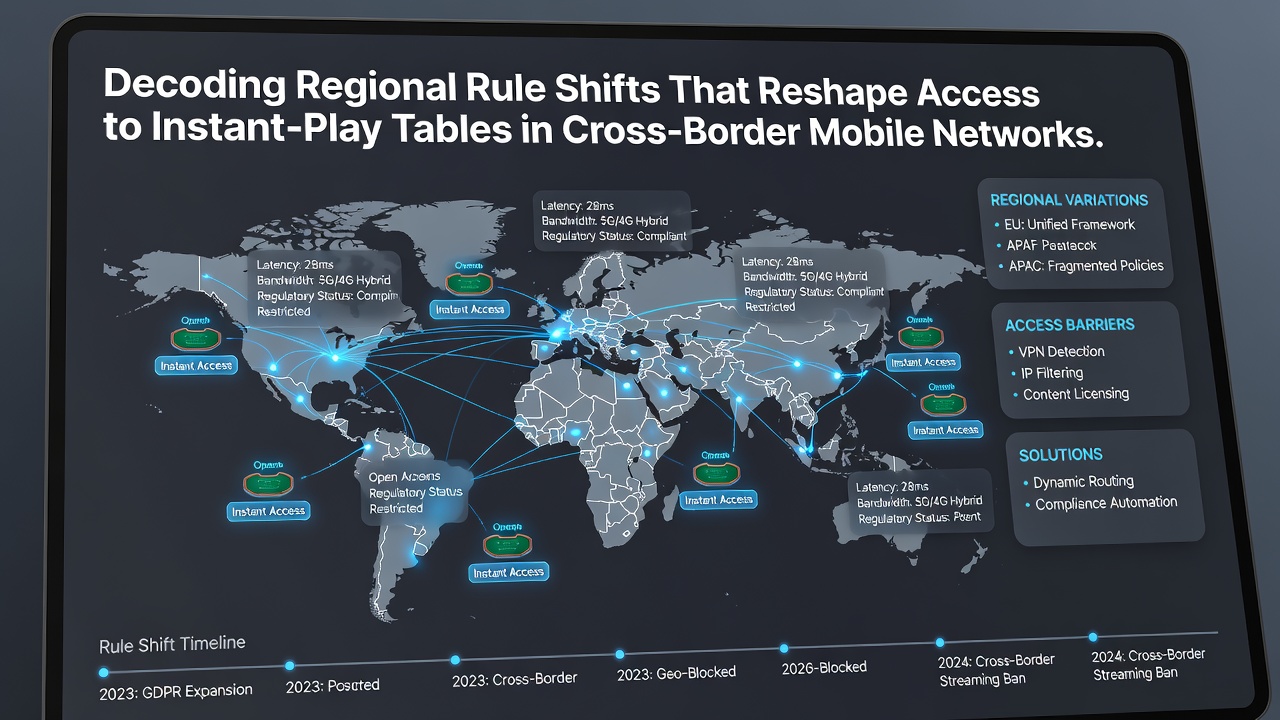
Network providers in border regions such as the Benelux area reported that traffic management systems now prioritize licensed pathways, which has streamlined connections for compliant users yet created temporary bottlenecks when multiple jurisdictions update their rules simultaneously. Those who have examined these systems note that the combination of automated geo-fencing and updated roaming agreements helps maintain service quality even as regulatory lines shift.
Asia-Pacific Developments
Policy changes in parts of Asia and the Pacific have introduced new requirements for data localization and transaction monitoring that directly affect how cross-border mobile networks deliver instant-play tables, and authorities in Australia along with several Southeast Asian markets implemented these rules progressively through the first half of 2026. Reports from the Australian Communications and Media Authority highlight that operators must now store certain user data within national borders, prompting mobile providers to establish additional regional nodes to keep latency low during live table sessions.
These adjustments have produced measurable differences in access reliability depending on a user’s proximity to approved data centers, and network engineers have responded by optimizing routing tables that balance regulatory compliance with connection stability. Studies tracking these changes indicate that players in areas with robust local infrastructure experience fewer interruptions compared to those relying on longer international routes.
Technical Responses from Mobile Networks
Mobile network operators have accelerated deployment of edge computing resources to handle the increased processing demands created by real-time regulatory checks, and this infrastructure expansion allows instant-play tables to remain responsive even when multiple verification layers run simultaneously. Industry reports show that partnerships between carriers and gaming platforms have grown more common as both sides work to meet compliance standards without sacrificing user experience.
Encryption standards and session management protocols have also evolved to accommodate the new requirements, with many networks adopting modular systems that can incorporate fresh rules from different jurisdictions as they emerge. Observers note that these technical adaptations have helped preserve access quality across borders where regulatory environments differ significantly.
Conclusion
Regional rule shifts continue to drive changes in how cross-border mobile networks deliver instant-play tables, and the combined effects of licensing updates, data requirements, and verification protocols shape access patterns in measurable ways. Evidence from regulatory bodies and research institutions demonstrates that operators and network providers have adapted through infrastructure upgrades and automated compliance tools, maintaining service continuity amid evolving frameworks as of June 2026.